
Many small business owners often want to understand the difference between a bookkeeper and a CPA for small businesses in the USA, especially when deciding how to manage finances, taxes, and compliance.
While both professionals work with financial information, their roles, authority, and responsibilities are very different. A bookkeeper focuses on maintaining accurate day-to-day financial records, while a CPA provides licensed expertise for tax filing, compliance, and strategic financial decisions.
Choosing the right financial support — or the right combination of both — can help small businesses stay organized, reduce risk, and make informed decisions as they grow.
Table of Contents
Key Takeaways
Bookkeepers manage daily financial records, transactions, and monthly reports.
CPAs are licensed professionals who handle taxes, compliance, and IRS representation.
Small businesses often benefit from using both a bookkeeper and a CPA at different stages.
Choosing the right financial support depends on business size, complexity, and growth goals.
What Does a Bookkeeper Do for a Small Business?
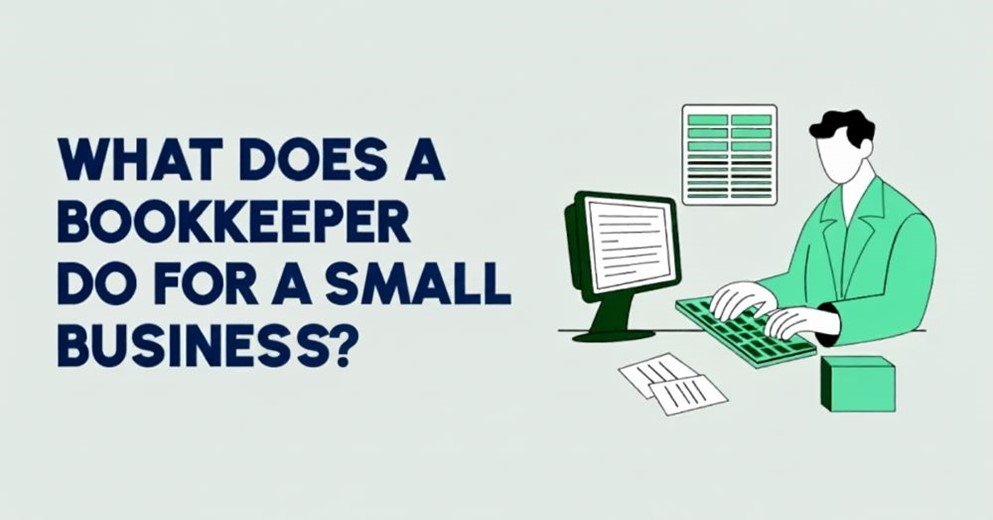
A bookkeeper is responsible for managing a small business’s day-to-day financial records. Their primary role is to ensure that every transaction is recorded accurately, categorized correctly, and organized in a way that keeps the business financially clear and tax-ready.
For small business owners, a bookkeeper provides structure and consistency. Instead of guessing where money is going or scrambling during tax season, bookkeeping creates reliable financial records that support better decisions and smoother compliance.
Daily Transaction Recording & Categorization
One of the most important tasks a bookkeeper handles is recording daily financial activity. This includes:
- Sales and income transactions
- Business expenses
- Bank and credit card activity
- Transfers between accounts
Each transaction is properly categorized so financial reports reflect the true state of the business. Accurate categorization is critical because it affects profit reporting, cash flow visibility, and how expenses appear during tax preparation.
Without proper bookkeeping, small errors can compound over time — leading to confusion, misreported numbers, or costly cleanup later.
Invoicing, Expense Tracking & Bank Reconciliations
Bookkeepers also help businesses stay organized by managing invoices and tracking expenses consistently. This ensures that:
- Customer invoices are recorded correctly
- Business expenses are not missed or duplicated
- Accounts remain balanced and accurate
A key part of this process is bank reconciliation. Each month, a bookkeeper compares bank statements with accounting records to confirm that all transactions match. This step helps catch errors early and keeps financial data reliable.
Payroll Coordination & Monthly Financial Reports
For many small businesses, bookkeepers assist with payroll coordination by ensuring payroll transactions are recorded correctly and aligned with accounting records. While they may not file payroll taxes themselves, they help maintain clean records that support compliance.
Bookkeepers also prepare monthly financial reports, such as:
- Profit & Loss statements
- Balance sheets
- Cash flow summaries
These reports give business owners a clear snapshot of financial performance and help identify trends before problems arise.
Bookkeeping Software & Tools Commonly Used
Modern bookkeeping relies on accounting software rather than manual spreadsheets. Bookkeepers typically work with tools such as cloud-based accounting platforms that allow real-time access to financial data.
Using proper tools improves accuracy, reduces manual errors, and makes collaboration easier between business owners, bookkeepers, and tax professionals.
When businesses choose to manage bookkeeping remotely using cloud tools, this approach is often referred to as virtual bookkeeping.
What a Bookkeeper Does Not Handle
Understanding the limits of a bookkeeper’s role is just as important as knowing what they do.
A bookkeeper typically does not:
- Prepare or file business tax returns
- Provide tax planning or tax strategy
- Represent businesses before the IRS
- Perform audits or financial reviews
- Offer legal or regulatory advice
These responsibilities fall under CPA-level services, which is where the distinction between a bookkeeper and a CPA becomes critical for small businesses.
Many small businesses work with a professional bookkeeping team to keep records accurate throughout the year, then rely on CPA-level expertise for tax filing and compliance — a structure that supports both accuracy and long-term growth.
What Does a CPA Do for Small Businesses in the USA?
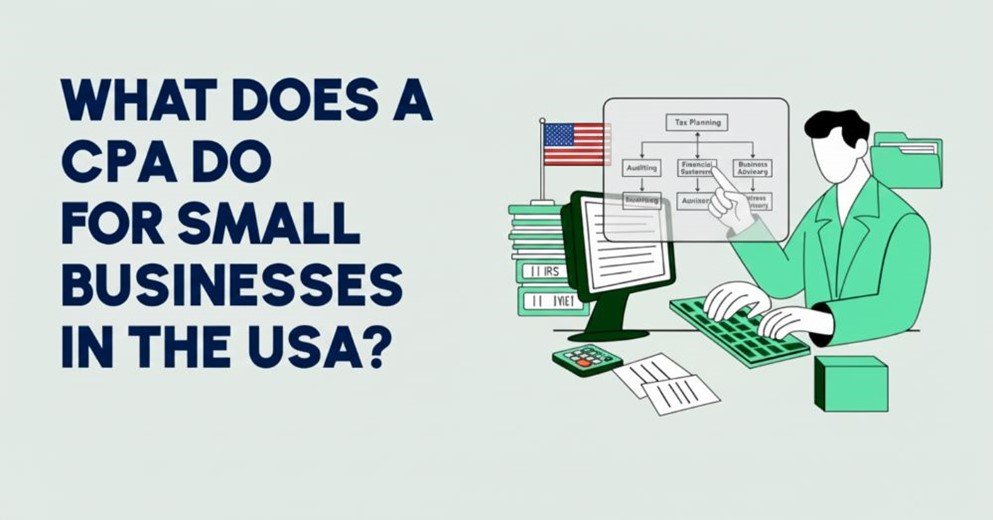
A Certified Public Accountant (CPA) plays a strategic and compliance-focused role for small businesses in the United States. Unlike a bookkeeper, a CPA is a licensed professional who is legally authorized to provide tax services, financial advice, and representation before the IRS.
For small businesses, CPAs are typically involved in tax planning, regulatory compliance, and higher-level financial decision-making, especially as the business grows or becomes more complex.
Tax Preparation and Tax Planning
One of the primary responsibilities of a CPA is preparing and filing business tax returns in accordance with U.S. tax laws. Beyond filing, CPAs help small businesses with tax planning, which includes:
- Identifying deductions and credits
- Structuring income and expenses efficiently
- Planning for estimated taxes
- Reducing tax exposure legally
Tax planning is not just about the current year — it helps businesses avoid surprises and make informed financial decisions throughout the year.
IRS Compliance and Representation Rights
A key difference between a CPA and a bookkeeper is legal authority.
CPAs are authorized to:
- Represent businesses before the Internal Revenue Service (IRS)
- Respond to IRS notices and audits
- Handle tax disputes and compliance issues
This authority is critical for small businesses facing audits, penalties, or complex tax matters.
Bookkeepers do not have the legal right to represent businesses before the IRS.
Financial Analysis and Advisory Support
CPAs go beyond record-keeping by providing financial analysis and strategic guidance. This may include:
- Reviewing financial statements
- Analyzing profitability and cash flow
- Assisting with budgeting and forecasting
- Supporting major business decisions
This advisory role helps business owners understand not just what the numbers are, but what they mean for the future of the business.
CPA Licensing and Legal Authority in the USA
In the United States, CPAs must meet strict licensing requirements, which typically include:
- A college degree in accounting or a related field
- Passing the Uniform CPA Examination
- Meeting state-specific experience requirements
- Ongoing continuing professional education
Because CPAs are licensed and regulated at the state level, they are held to professional and ethical standards that protect businesses and ensure compliance.
When CPA Involvement Becomes Necessary
While not every small business needs a CPA at every stage, CPA involvement becomes important when:
- The business has complex tax obligations
- Multiple revenue streams or entities are involved
- The business is growing rapidly
- Regulatory or compliance requirements increase
- Strategic financial decisions are required
At this stage, CPA-level expertise helps reduce risk, improve planning, and support sustainable growth.
Many small businesses rely on a bookkeeper for daily financial management and bring in a CPA for tax filing, compliance, and higher-level financial oversight — a combination that balances efficiency, accuracy, and expert guidance.
Do Small Businesses Need Both a Bookkeeper and a CPA?
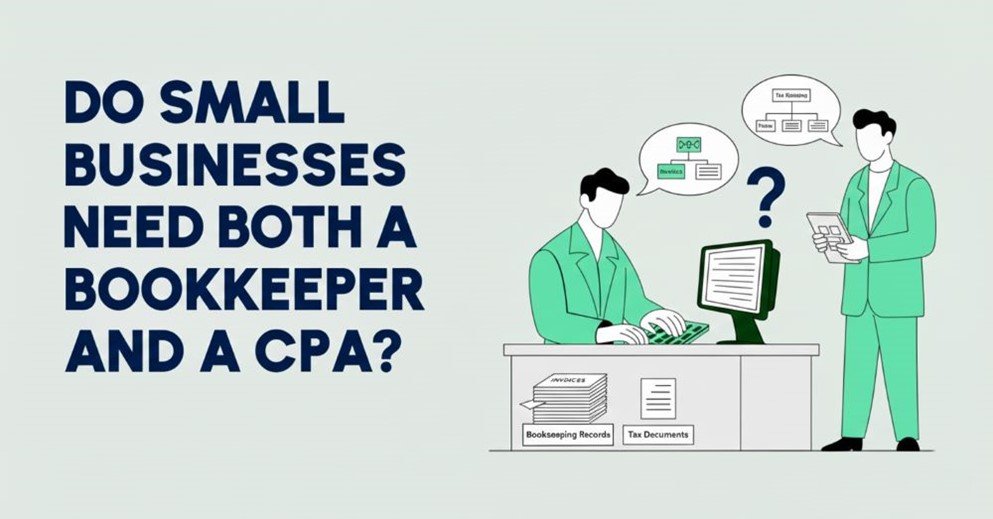
Many small business owners assume they must choose between a bookkeeper or a CPA. In reality, most successful small businesses rely on both professionals at different stages — and often at the same time.
A bookkeeper and a CPA serve distinct but complementary roles. When used together correctly, they help businesses stay organized, compliant, and financially prepared for growth.
Why Relying on Only One Can Limit Growth
Relying solely on a bookkeeper or only on a CPA can create gaps in financial management.
- A bookkeeper alone may keep records accurate but cannot provide tax strategy, compliance oversight, or legal representation.
- A CPA alone may handle taxes and planning but is not designed to manage daily transaction accuracy month after month.
Without consistent bookkeeping, CPAs are often forced to correct messy or incomplete records — increasing costs and reducing efficiency. Without CPA oversight, businesses risk missed tax opportunities, compliance issues, or strategic blind spots.
How Bookkeepers and CPAs Work Together
In a well-structured setup, bookkeepers and CPAs operate as a coordinated financial team.
- Bookkeepers handle daily transactions, reconciliations, payroll records, and monthly reports.
- CPAs review those records, prepare and file tax returns, provide tax planning, and offer strategic guidance.
This collaboration ensures financial data is accurate before it reaches the CPA — making tax filing smoother, faster, and more cost-effective.
When Should a Small Business Hire a Bookkeeper vs a CPA?
Most small businesses follow a natural progression.
A business typically starts with a bookkeeper when:
- Daily transactions increase
- Financial records become time-consuming to manage
- Monthly reporting is needed for clarity and control
CPA involvement becomes essential when:
- Tax obligations grow more complex
- The business structure expands (LLCs, S-corps, multiple entities)
- Strategic planning, compliance, or IRS interaction is required
As businesses grow, maintaining both roles becomes the most efficient and lowest-risk approach.
A Practical Hybrid Model for Small Businesses
Many small businesses use a hybrid financial model:
- Ongoing bookkeeping to maintain clean, accurate records
- CPA-level oversight for tax filing, compliance, and strategic decisions
This model balances cost efficiency, accuracy, and professional oversight, allowing business owners to focus on growth while staying compliant year-round.
Bookkeeper vs CPA: Side-by-Side Comparison
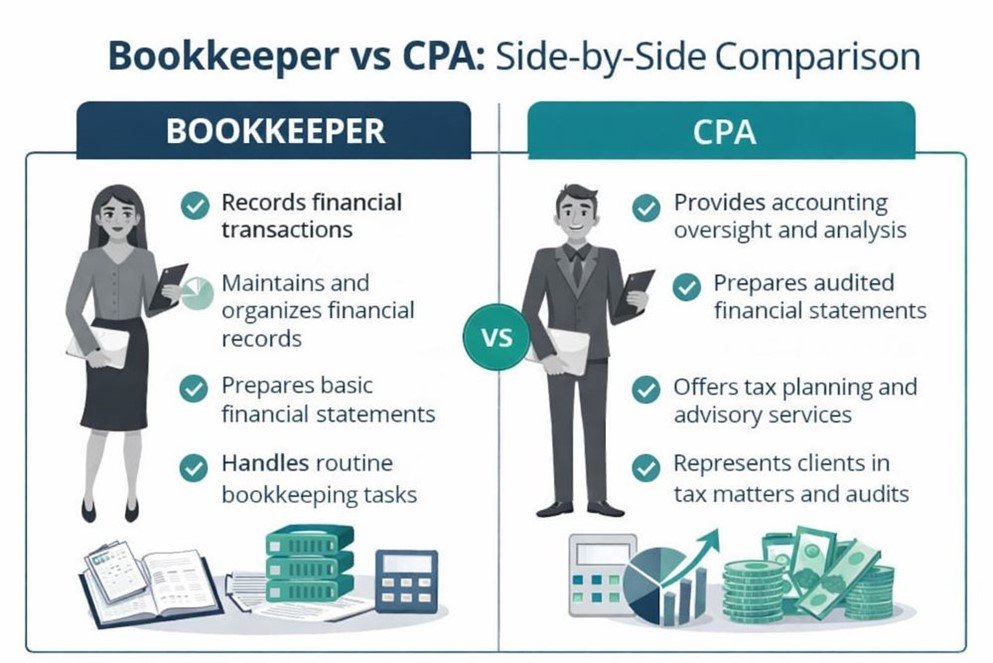
Small business owners often compare bookkeepers and CPAs to understand which professional fits their needs. While both work with financial data, their roles, authority, and responsibilities are very different.
Below is a clear side-by-side comparison to help you decide.
Bookkeeper vs CPA – Comparison Table
| Category | Bookkeeper | CPA (Certified Public Accountant) |
|---|---|---|
| Primary Role | Manages day-to-day financial records | Handles tax, compliance, and strategic finance |
| Daily Transactions | Records and categorizes transactions | Reviews summarized financial data |
| Invoicing & Expenses | Tracks invoices, expenses, and payments | Uses reports for tax and planning purposes |
| Bank Reconciliation | Performs monthly reconciliations | Reviews reconciled data when needed |
| Payroll Support | Records payroll transactions | Handles payroll tax compliance (if engaged) |
| Financial Reports | Prepares monthly reports (P&L, Balance Sheet, Cash Flow) | Analyzes reports for decision-making |
| Tax Return Filing | ❌ Cannot file business tax returns | ✅ Prepares and files tax returns |
| Tax Planning & Strategy | ❌ Not authorized | ✅ Provides tax planning and optimization |
| IRS Representation | ❌ Not allowed | ✅ Can represent businesses before the IRS |
| Audits & Reviews | ❌ Cannot perform | ✅ Authorized to conduct audits and reviews |
| Licensing Requirement | No formal license required (certifications optional) | State-licensed professional |
| Cost Level | Lower, ongoing operational cost | Higher, strategic and compliance-focused |
| Best For | Daily financial organization and accuracy | Compliance, tax matters, and business growth |
How Small Businesses Typically Use Both
Many small businesses do not choose one over the other. Instead, they use a layered approach:
- A bookkeeper manages daily records and keeps finances organized
- A CPA steps in for tax filing, compliance, and strategic decisions
This structure helps maintain accuracy throughout the year while ensuring proper tax handling and long-term planning.
Cost Comparison — Bookkeeper vs CPA in the USA
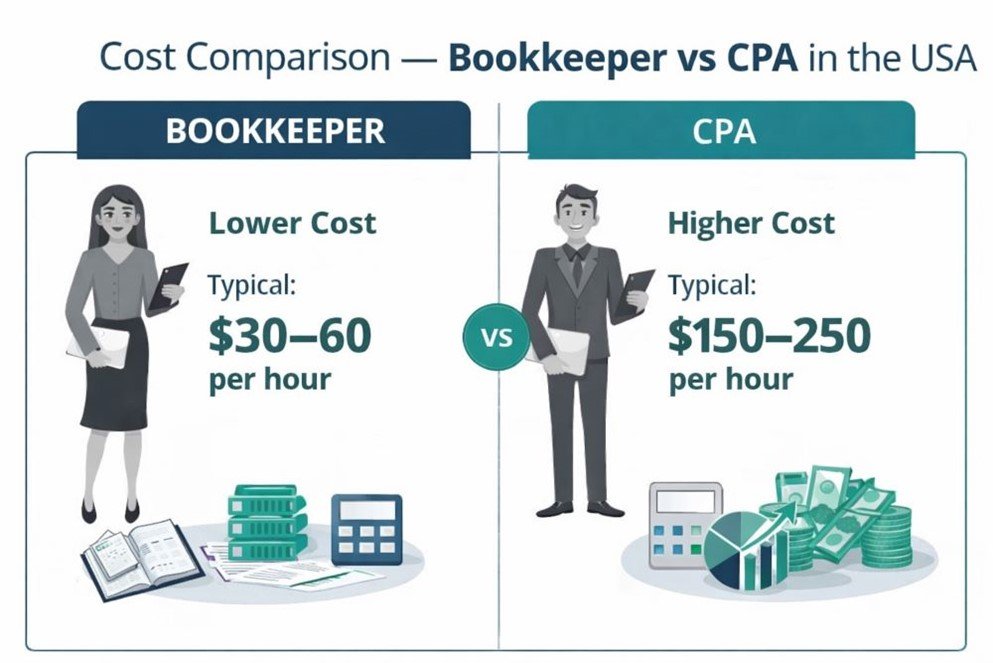
Cost is one of the biggest factors small business owners consider when deciding between a bookkeeper and a CPA. While both professionals provide financial support, their pricing reflects very different roles and levels of responsibility.
Understanding these cost differences helps businesses choose the right support without overpaying or under-investing.
Typical Bookkeeper Costs for Small Businesses
Bookkeeping services are generally more affordable because they focus on routine, ongoing financial tasks rather than compliance or legal authority.
For most small businesses, bookkeeping costs depend on:
- Monthly transaction volume
- Number of accounts and payment methods
- Payroll complexity
- Reporting frequency
Bookkeepers are commonly engaged on a monthly or ongoing basis, which allows businesses to budget predictably while keeping financial records consistently updated.
This makes bookkeeping a cost-effective foundation for day-to-day financial management.
Typical CPA Costs and Pricing Structure
CPA services usually cost more because they involve licensed expertise, regulatory responsibility, and legal authority.
CPA fees are influenced by:
- Business structure and entity type
- Complexity of tax filings
- Advisory or planning requirements
- IRS correspondence or compliance work
Unlike bookkeeping, CPA services are often billed:
- Per engagement
- Per tax return
- Or for specific advisory projects
This means CPAs are typically used periodically or strategically, rather than for daily financial tasks.
Short-Term Cost vs Long-Term Value
Comparing costs alone can be misleading without considering long-term value.
- Bookkeeping helps prevent errors by keeping records accurate throughout the year
- CPA oversight helps prevent penalties, missed deductions, and compliance risks
Businesses that delay CPA involvement often face:
- Costly corrections
- Tax surprises
- Increased audit risk
In contrast, businesses that combine clean bookkeeping with timely CPA guidance often experience lower overall risk and smoother tax seasons.
Which Option Is More Cost-Effective for Small Businesses?
For most U.S. small businesses, the most cost-effective approach is not choosing one over the other, but using each professional where they add the most value.
- Use a bookkeeper for ongoing financial accuracy and organization
- Use a CPA for taxes, compliance, and strategic decisions
This approach avoids paying CPA-level fees for routine tasks while ensuring expert oversight when it matters most.
Common Myths About Bookkeepers and CPAs
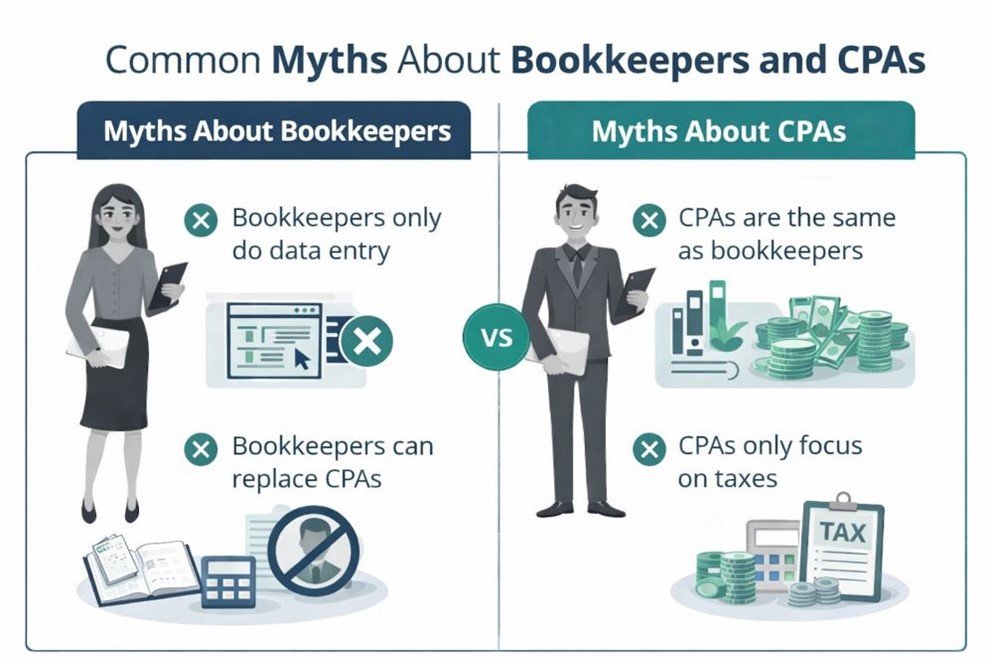
Many small business owners make financial decisions based on assumptions that aren’t always accurate. Clearing up these common myths helps businesses avoid costly mistakes and choose the right financial support with confidence.
Bookkeepers and CPAs Do the Same Job
This is one of the most common misconceptions.
While both work with financial information, their responsibilities are very different. Bookkeepers focus on recording and organizing financial data, while CPAs focus on tax compliance, legal authority, and strategic guidance.
Accurate bookkeeping supports good decision-making, but it does not replace CPA-level expertise when taxes, compliance, or complex planning are involved.
A CPA Is Always Better Than a Bookkeeper
A CPA is not a replacement for a bookkeeper.
CPAs are highly trained professionals, but using a CPA for daily transaction management is often unnecessary and inefficient. Most small businesses benefit from a bookkeeper handling routine financial work and a CPA stepping in when advanced expertise is required.
Choosing “more expensive” does not always mean choosing “more appropriate.”
Small Businesses Don’t Need a CPA
Some business owners believe CPAs are only necessary for large companies. In reality, many small businesses need CPA involvement earlier than expected, especially when:
- Tax obligations become more complex
- Business structures change
- Compliance risks increase
Even limited CPA involvement can help small businesses avoid penalties, missed deductions, and long-term financial issues.
Bookkeeping Is Only Needed at Tax Time
Bookkeeping is not a once-a-year task.
Without consistent bookkeeping throughout the year, businesses often face:
- Inaccurate financial reports
- Last-minute corrections
- Higher CPA costs during tax season
Ongoing bookkeeping ensures that financial records are always up to date and ready for review when needed.
Hiring Both Is Too Expensive
Hiring both a bookkeeper and a CPA is often more cost-effective than relying on one professional to handle everything.
By assigning routine work to a bookkeeper and specialized tasks to a CPA, businesses avoid overpaying for services while still maintaining accuracy and compliance.
This balanced approach reduces risk and improves long-term financial stability.
How to Choose the Right Financial Professional for Your Business

Choosing the right financial professional isn’t about selecting the most expensive option — it’s about matching expertise to your business’s current needs and future goals.
Small businesses benefit most when they evaluate scope, complexity, and risk, rather than titles alone.
Questions to Ask Before Hiring a Bookkeeper or CPA
Before hiring any financial professional, small business owners should ask clear, practical questions, such as:
- What specific services do you provide?
- How do you handle businesses similar to mine?
- Will you coordinate with other financial professionals if needed?
- How do you ensure accuracy and compliance?
- How often will I receive financial reports or updates?
Clear answers help avoid misunderstandings and ensure expectations are aligned from the start.
Consider Your Business Size and Complexity
The size and structure of your business play a major role in determining the level of financial support you need.
- Smaller businesses with straightforward transactions often benefit from consistent bookkeeping support.
- Growing businesses with multiple revenue streams, employees, or entities often require CPA-level oversight.
As complexity increases, the need for compliance and strategic guidance becomes more important.
Industry and Compliance Considerations
Some industries face higher regulatory or tax complexity than others.
Businesses operating in regulated industries, multi-state operations, or sectors with specialized tax rules often benefit from early CPA involvement to reduce compliance risk.
Understanding your industry’s requirements helps you choose the right mix of bookkeeping and CPA support.
Plan for Growth, Not Just Today
Financial needs evolve as a business grows.
Choosing professionals who can scale with your business helps avoid disruptions later. Many small businesses start with bookkeeping support and add CPA services as their operations expand.
Planning ahead ensures continuity, accuracy, and long-term financial stability.
When businesses understand their financial needs and plan accordingly, they are better positioned to make confident decisions and avoid costly mistakes.
Frequently Asked Questions
Do I need a bookkeeper or a CPA for my small business?
It depends on your business size, complexity, and stage of growth.
- If you need help with daily financial records, a bookkeeper is usually enough.
- If you need tax filing, tax planning, or IRS representation, you’ll need a CPA.
Many small businesses use both — a bookkeeper for daily management and a CPA for taxes and compliance.
What’s the difference between a bookkeeper and a CPA?
The main difference is scope and legal authority.
- A bookkeeper manages day-to-day financial records and reports
- A CPA is licensed to file taxes, provide tax strategy, and represent businesses before the IRS
Bookkeepers focus on accuracy and organization, while CPAs focus on compliance and strategy.
Is a CPA worth it for a small business?
Yes — when your business reaches a certain level of complexity.
A CPA is worth the cost if your business:
- Has complex tax obligations
- Is growing rapidly
- Needs tax planning or compliance support
- Faces IRS notices or audits
For basic record-keeping alone, a CPA is often unnecessary.
What type of accounting is best for small businesses?
There is no one-size-fits-all answer.
- Simple or early-stage businesses → Bookkeeping-focused
- Growing businesses → Bookkeeping + CPA oversight
- Complex or regulated businesses → CPA-led with bookkeeping support
The best setup balances cost efficiency, accuracy, and compliance.
How much do small businesses usually pay for bookkeeping services?
Bookkeeping costs vary based on transaction volume, complexity, and tools used.
Most small businesses pay for:
- Monthly bookkeeping services
- Cloud-based bookkeeping support
- Software-assisted record management
Costs increase as transaction volume and reporting needs grow.
How much does QuickBooks bookkeeping cost for small businesses?
QuickBooks bookkeeping costs depend on:
- Business size
- Number of monthly transactions
- Required reports and reconciliations
Businesses using QuickBooks often combine software with professional bookkeeping support for accuracy and consistency.
Is virtual bookkeeping worth it for small businesses?
Yes, for many small businesses.
Virtual bookkeeping offers:
- Remote access to financial records
- Lower overhead costs
- Real-time collaboration
- Scalable support as the business grows
It is especially useful for businesses that operate remotely or across multiple locations.
Do small businesses need both a bookkeeper and a CPA?
In many cases, yes.
A common and effective structure is:
- Bookkeeper → Manages daily financial records
- CPA → Handles tax filing, compliance, and strategic guidance
This approach keeps finances organized year-round while ensuring proper tax handling.
Final Thoughts
Choosing between a bookkeeper and a CPA isn’t about picking one title over another — it’s about understanding what your business needs at its current stage.
For most small businesses in the USA:
- Bookkeepers provide the structure, accuracy, and consistency needed for day-to-day financial management.
- CPAs provide the expertise required for tax compliance, strategic planning, and regulatory confidence.
As a business grows, the most effective and lowest-risk approach is often a combination of both — accurate bookkeeping throughout the year, supported by CPA-level oversight when taxes, compliance, or major decisions are involved.
When financial roles are clearly defined and aligned, business owners gain clarity, reduce risk, and make better decisions with confidence.
Schedule a Free Consultation
If you’re unsure whether your business needs a bookkeeper, a CPA, or a combination of both, speaking with an experienced professional can help you avoid costly mistakes.
A short consultation can help clarify:
- What level of financial support your business actually needs
- Where gaps or risks may exist
- How to structure bookkeeping and CPA services efficiently
Schedule a free consultation to discuss your business needs and get expert guidance tailored to your situation.